Popular Posts

Showing posts with label Great Literature. Show all posts

Saturday, January 2, 2010

THE ELISSON BOOKSHELF

The Elisson Bookshelf

Another installment in the ongoing series entitled “What I’ve Been Reading Lately.”

It’s a new year and a new decade, as good a time as any to update my Booky List. Here goes:

September
  • Small Gods - Terry Pratchett

    Pratchett has a brilliant, snarky sense of humor. I’m actually a bit peeved that I liked this book so much, because there are so many more Discworld novels to read.

  • Flood - Stephen Baxter

    Never mind something as trivial as Global Warming. What if something changed deep within the Earth, something that caused enormous quantities of water to be released from deep within the Earth’s mantle... enough to cover the world’s entire landmass with new ocean within the next half-century? An unlikely scenario, but one that forms the backdrop for this thoughtful SF novel.

  • The Lost Symbol - Dan Brown

    Dan Brown’s novels are fun to read and not too taxing on the brain. Afterwards, however, I feel like I need to wash a thin but persistent coating of Stupid-Juice from my brain.

October
  • Plato and a Platypus Walk Into a Bar: Understanding Philosophy Through Jokes - Thomas Cathcart and Daniel Klein

    This little book was an unexpected pleasure. I’m not sure what I enjoyed more: the jokes, or the philosophical context into which the authors place them.

  • Have a Little Faith - Mitch Albom

    Mitch Albom is not normally my cup of tea: a shitload bit too much on the mawkish and sentimental side for my cynical worldview. But I had to read this, his first nonfiction work since 1997’s Tuesdays with Morrie, because half the book is about Rabbi Albert Lewis... our very own rabbi’s late father.

  • Hitler’s War - Harry Turtledove

    Every time Harry Turtledove comes out with yet another alternate history novel based on some permutation of World War II, I tell myself I’m not gonna buy it... and then I do anyway. Schmuck.

  • The Book of Genesis - Robert Crumb

    The first book of the Bible (both Hebrew and Christian), as brought to visual life by Crumb’s India ink and crowquill pens. Not exactly what you’d expect from the creator of Zap Comix... and it’s a thoroughly faithful rendition.

November
  • The Defector - Daniel Silva

    Yet another Gabriel Allon novel... and one of Silva’s best.

  • Plutonium: A History of the World’s Most Dangerous Element - Jeremy Bernstein

    I like reading about Dangerous Substances. Bernstein is not the most lucid writer, but the material is fascinating.

December
  • The End of Overeating: Taking Control of the Insatiable American Appetite - David Kessler

    You’ll never be able to look at the menu at Chili’s the same way again. This book does a great job of explaining why America has a collective Fat Ass.

  • Under the Dome - Stephen King

    Every once in a while, King will crank out a massive tome (this one clocks in at over 1060 pages), and I read it, hoping he has written another The Stand. This one doesn’t quite make it. It starts off just fine, with a brutal murder within the first few pages... plenty of Evil Shenanigans... and it builds to what could have been a huge, powerful climax... but then it just sorta goes flat. Meh.

  • Manhood for Amateurs: The Pleasures and Regrets of a Husband, Father, and Son - Michael Chabon

    In this collection of essays, all connected somehow with the business of being a Man in Modern America, Chabon is nostalgic, wistful, loving, tender, perverse, insightful, and funny.

So: What have you been reading lately?

Thursday, September 17, 2009

YET ANOTHER HEINOUS INDIGNITY

I’ve been posting pictures of my Extremely Photogenic Kitties for over five years now... and during that time, during my journeys on the Information Stoopidhighway, I’ve seen cats subjected to all kinds of indignities in the search for amusing blog-fodder. Do I need to mention LOLcats? Or I Can Has Cheezburger?

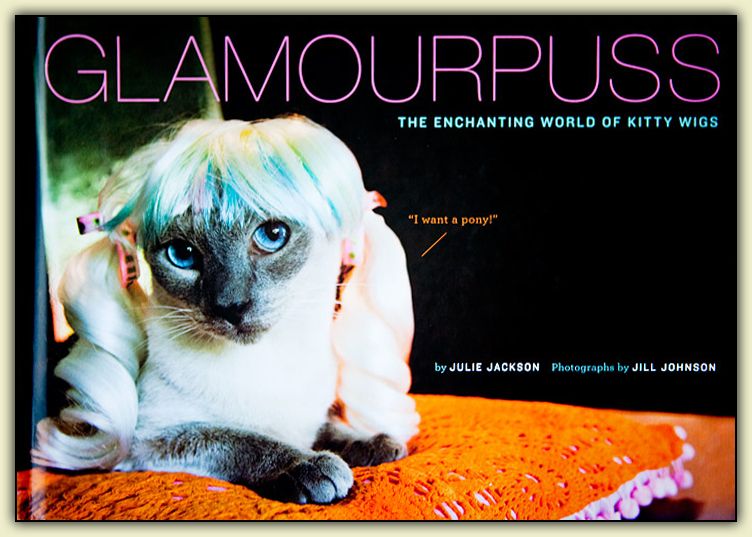
But this... this is so fucking wrong, I don’t even know why I am dignifying it with a link. Except I know that when the Mistress of Sarcasm sees this picture, she will laugh until she passes a blood clot.

Glamourpuss
Photo by Heather Armstrong.

Yes, this is a real book. And no, that is not Hakuna on the cover.

[Tip o’ th’ Elisson fedora to the most estimable dooce for the link.]

Saturday, August 15, 2009

THE ELISSON BOOKSHELF

The Elisson Bookshelf

Yet another installment in a series entitled “What I’ve Been Reading Lately.”

It has been eight months to the very day since I last posted about what I’ve been reading, so it’s as good a time as any for me to inflict this latest update on my Esteemed Readers. Here’s what I have read since mid-December of last year:

December
  • Wicked: The Life and Times of the Wicked Witch of the West - Gregory Maguire

    The familiar story of the Wizard of Oz, told from a different perspective. It’s a darker tale than the Broadway musical it inspired would have you believe.

  • From Krakow to Krypton: Jews and Comic Books - Arie Kaplan

    The title pretty much tells it all. I had grown up knowing that the Jewish footprint in the comics industry was large, but it was only in my adult years that I learned just how large.

January
  • Devil in the Details - Jennifer Traig

    Seriocomic memoir of a young woman’s struggles with crippling OCD. Hysterical.

February
  • My Jesus Year - Benyamin Cohen

    A year-long adventure in seeing “how the other half lives.” Jew sets out to figure out the Christian world.

  • The Saturday Wife - Naomi Ragen

    Blisteringly funny tale of a social-climbing rebbitzin (rabbi’s wife) and the havoc she wreaks.

  • The First Patient - Michael Palmer

    Inexpertly-written thriller... but a good airplane read.

March
  • Maps and Legends - Michael Chabon

    Chabon never fails to entertain, this time with an extended rumination on time, place, and legend.

April
  • Watchmen - Alan Moore and Dave Gibbons

    Somehow, I managed to miss this one, despite its having been around since 1986-87. But it was more than worth the wait: Watchmen mat be the single most ambitious and thought-provoking graphic novel ever written.

  • For Decades I Was Silent: A Holocaust Survivor's Journey Back to Faith - Baruch G. Goldstein

    Many Holocaust survivors made it out of the death camps with minds and bodies more-or-less intact, but with faith flayed away by the perception of seeming indifference on the part of the Eternal. Mr. Goldstein shows how his experiences during the Holocaust strengthened, rather than destroyed, his own belief in God.

May
  • The League of Extraordinary Gentlemen (Volume One) - Alan Moore and Kevin O’Neill

  • The League of Extraordinary Gentlemen (Volume II) - Alan Moore and Kevin O’Neill

    Another pair of masterworks by Alan Moore, these being set in a steampunk London and featuring literary characters pulled from the worlds of adventure and SF. No Watchmen, but an excellent option for those who enjoy graphic novels. Worth reading if only to get the taste of the movie version out of your mouth.

  • V for Vendetta - Alan Moore and David Lloyd

    Yes, more Moore. Brilliant, dark story set in an Orwellian fascist England.

  • Make ’Em Laugh: The Funny Business of America - Michael Kantor and Laurence Maslon

    Companion to the PBS series, this massive coffee-table tome has vignettes about almost all the important American comedians of the twentieth century. No real in-depth analyses, but a fine overview of how these funny people influenced our shared culture.

June
  • The Golden Ocean - Patrick O’Brian

  • The Unknown Shore - Patrick O’Brian

    Two novels that preceded the famous Aubrey-Maturin series by almost two decades. You can see early versions of Jack Aubrey and Stephen Maturin in The Unknown Shore; it is a pleasurable taste of things to come.

July
  • Abraham's Knife: The Mythology of the Deicide in Antisemitism - Judith Civan

    A fascinating study of the enduring myth of the Jews as Christ-killers. I met the author and am sad to report that her personality is not nearly as fascinating as her book.

  • The Best Short Stories of J. G. Ballard - J. G. Ballard

    Ballard’s death inspired me to get this collection of his short fiction, of which I had previously read only a few pieces.

  • Next - Michael Crichton

    Crichton’s penultimate book examines several potential consequences of gene-manipulation technology.

August
  • This Will Kill You: A Guide to the Ways in Which We Go - HP Newquist, Rich Maloof

    Amusing compendium of various diseases and violent events with unpleasant and/or unfortunate outcomes.

  • Company Aytch: Or, a Side Show of the Big Show - Sam Watkins

    Documentarian Ken Burns relied heavily on Sam Watkins’s memoirs of the Late Unpleasantness (i.e., the American Civil War). Watkins, who wrote about his experiences as a private “webfoot” soldier some twenty years after the conflict, provides an up-close-and-personal “eyes on the ground” perspective that is very different from the usual histories. His epistles, which were published serially in the Columbia, Tennessee newspaper, were later collected and published as a book; they read like a late nineteenth-century blog might have read.

  • A Trip of Goats - Kim Crawford

    A memoir of the mid-Sixties South, written in a style that seems to combine elements of William Faulkner and Hunter S. Thompson, this book cries out to be made into a movie. Alternately tender and hysterically funny (mostly funny). Yes, I know the author... but his remarkable capacity for assholery has in no way affected my impressions of his writing. Strongly recommended!

Next up we have Small Gods, one of Terry Pratchett’s Discworld novels, and Denis Kitchen’s big book about Harvey Kurtzman, the legendary artist who, among other feats, created the cultural H-bomb known as Mad. When I finish these two, I will have logged 300 books since January 2002, when I began keeping track.

So: What have you been reading lately?

Thursday, August 6, 2009

ANNUAL REPORT

Last quarter’s Sales were better than before;
     Thanks be to Perfumes, Lipstick, and the Like;
Our Forecast, optimistic: Profits more
     Than those of prior Quarter’s Sales Spike.

The overseas Divisions send Report;
     A story of Net Income past Compare;
And Earnings fuel’d by Products of the Sort
     That may be worn on Skin or in the Hair.

The economic Downturn’s ill Effects
     Have little Impact, as we know quite well,
Upon th’Attraction that the Fairer Sex
     Enhanceth with an Artificial Smell.

The Auditors state that our Reck’ning’s good;
     Now go and vote your Proxy as we would.

- The Board of Avon

GET YOUR GOAT

A Trip of GoatsLooking for something entertaining to read at the beach? Or for those long sessions on the Throne? Or to slip behind a Corporate Report cover so you can have a few moments of enlightenment during a boring meeting?

I’ve got just the thing for you. Go getcha a copy of A Trip of Goats, by one Kim Crawford.

Many of my Esteemed Readers are already familiar with Mr. Crawford’s sometimes vitriolic, often amusing prose. And a few are even familiar with Mr. Crawford’s sometimes vitriolic, often amusing behavior. If you’re in either part of that Bloggy Venn diagram, you’ll have some idea of what to expect from A Trip of Goats. And if not, it will be a glorious and perverse surprise.

Having read several early drafts of this, Mr. Crawford’s first novel, I can recommend it without reservations. Well, maybe one reservation. It’s awfully fucking expensive for a 6 x 9" paperback. I guess somebody has to pay for all the smokes and firewater.

Whet your appetite here, where the inimitable Velociman has provided some book-pimpage as well as a wee sample. Then go here and buy the frickin’ thing.

And while you’re at it, you can buy my book too... from the much more user-friendly Amazon website.

Sunday, April 5, 2009

WATCHMEN

Watchmen

A couple of days ago, I caught the Watchmen movie. The fact that I saw it on a weekday afternoon (a privilege of the Retired Individual) about a month after its release meant that I saw it in a theatre that was completely empty, save for myself.

I am embarrassed to say that I had been unfamiliar with the source material, a twelve-issue series of comic books originally published in 1986-87 and later repackaged as a Graphic Novel. Somehow or other, it never managed to hit my radar screen, even over a two-decade-plus span. Maybe if I spent more time at comics conventions... but no.

When I saw the advance advertising for the movie, I was fascinated. Who were these costumed characters, anyway? (Especially the Silk Spectre - yow!) I had to find out more. And so I resolved to read the graphic novel before seeing the movie.

There’s always a danger in comparing any movie to its Booky Source. Almost inevitably, changes must be made in adapting a book to the Big Screen... and in almost every case, those changes are the source of disappointment and frustration. Sometimes it is the excision of plot elements or characters that make it more difficult to tell a story visually; sometimes it’s a wholesale reimagining that (generally) does little to enhance the story. And, at the very least, converting a book to a film changes it from a “hot” medium to a “cold” one, as Marshall McLuhan might say: from one that forces your own imagination to do the heavy lifting to another in which a director, cinematographer, and actors (among others) have done it for you.

With a graphic novel, it’s a little different. The book is really a form of extended storyboard, a movie in the process of becoming. How do you put it on the screen and manage to give it a life of its own without taking away the graphic impact and the storytelling techniques that work so well on the page? If you don’t know what you’re doing, you can end up with a disappointing clusterfuck like The League of Extraordinary Gentlemen, not incidentally, another Alan Moore creation that, alas, did not fare well in the transition from Page to Screen.

But let’s deal with that later. What about the graphic novel, a novel that received the Hugo Award in 1988 and has been included in Time Magazine’s 2005 list of the best 100 English-language novels written since 1923? Does it live up to the hype? Is it all that?

Watchmen - the graphic novel - is all that.

The story is set in the year 1985, in a world that is similar to our own. But there are a few critical differences, for this is a world in which costumed heroes enjoyed a decades-long surge of popularity that began in the late 1930’s. Not in comic books, as in our own world, but in real life.

These dressed-up vigilantes - for that is, indeed, what they are - are no superheroes. They’re martial-arts experts, some assisted with gadgetry à la Batman, others only by their own brutal capabilities and internal moral compass - or lack thereof. The exception - the only one with real superpowers - is Jon Osterman, AKA Dr. Manhattan, who, owing to a bizarre nuclear accident, now has godlike powers over matter, space, and time.

It is through Dr. Manhattan’s efforts that the Vietnam War ends in a U.S. victory, a victory that propels Richard Nixon to electoral success in five consecutive terms. But meanwhile, under pressure from local police forces, Congress has outlawed the activities of costumed heroes, causing the ones still active to either retire (e.g., Nite Owl, Silk Spectre) or go underground (Rorschach). The exceptions are Adrian Veidt, AKA Ozymandias (“The Smartest Man in the World”), who retired early to build an empire on (among other things) costumed hero action figures; and the brutal, amoral Comedian, who, along with Dr. Manhattan, continues to work under the auspices of the U.S. Government. It is the Comedian who rescues the U.S. Embassy hostages in Iran in this world... presumably in a suitably take-no-prisoners manner.

It’s a world rife with many of the tensions with which we were familiar in the mid-1980’s. The superpowers are at each other’s throats and the threat of nuclear annihilation - kept at bay mainly through the presence of Dr. Manhattan - is in the air. And someone has murdered the Comedian...

I won’t say much more, except that the story is richly layered, incorporating the characters’ respective origins as well as “current” events and told, at times, in brilliant counterpoint, with multiple story elements weaving in and out. And there is one critical “hat tip” towards the end... an element sadly missing from derivative entertainments like the movie Idiocracy. Watchmen honors its sources.

The film? Given the brilliant writing and graphics of the source, the film makes an attempt to capture those elements as faithfully as possible... and mostly succeeds. The story is told in the same contrapunctal style, with a few necessary omissions and (understandable, albeit regrettable) alterations. Some critics have caviled, complaining that the film is too faithful to the source, to the point where it is constricting. I disagree. I think Watchmen, the movie, brilliantly brings Watchmen, the graphic novel, to life.

It’s a violent film, with some genuinely bloodcurdling moments. It’s got sex - that hard “R” rating is well-deserved. It’s dark... darker than any of the Christian Bale Batman movies. It’s a Costumed Superhero movie completely unlike any other, one that knowingly turns the conventions of the genre on their heads while simultaneously paying homage to them. And it is Just. Plain. Fucking. Amazing.

One of the subtexts of both the graphic novel and the film is that the costumed heroes are presented as thoroughly and completely human. Which means they all have a few loose screws... because what kind of person dresses up in a costume in order to beat up on criminals? A Borderline Nutcase, that’s what kind. Even Dr. Manhattan, who is more god than human (and who, during the course of the story, becomes ever more detached from humanity), is thoroughly human at his core. It’s a tribute to Alan Moore’s writing skills - and Jackie Earle Haley’s acting skills - that Rorschach, a character seething with righteous fury and alienation, is perhaps the most heartbreakingly human of them all.

I’m actually glad it took me this long to discover Watchmen. If I had read that graphic novel in the 1980’s and found out that they were going to make a movie out of it, I would have had to suffer years of frustration as the project wound its way through the seven circles of Development Hell. This way, no frustration... except the frustration of knowing that the Missus probably wouldn’t enjoy the film like I did.

If you want to see a Comic Book Movie that is unlike any other... one that makes all those Superman, Batman, Spiderman, and X-Men movies look trivial and childish... one that shows a deep understanding of the World of the Hero... go see Watchmen. You’ll never look at one of those yellow Smiley-Face buttons the same way again.

Monday, December 15, 2008

THE ELISSON BOOKSHELF

The Elisson Bookshelf

Being yet another installment in a series entitled “What I’ve Been Reading Lately.”

My last Bookshelf Post was, appropriately enough, on April Fool’s Day, over eight months ago. And now, what with all of the holiday gift shopping going on in these short weeks before the year-end frenzied confluence of Christmakwanzakah, it’s an excellent time for me to stand here in my Bully Electronic Pulpit and pontificate about what I have been reading. Who knows? Perhaps you may be influenced by my impeccable Literary Selections unto the point of purchasing them for yourself...or giving them as gifts. Or picking ’em up at the library, the most economical alternative.

Here’s what I have read since early April:

April
  • The Ten-Cent Plague: The Great Comic Book Scare and How It Changed America - David Hadju

    A look at the world of pre-Code comics and the paranoid cultural struggle that led to their replacement by the sanitized tripe with which we are all too familiar. Carefully researched and entertainingly written.

  • Lost Horizon - James Hilton

    The book that gave us the term “Shangri-La,” this was the first novel ever to be published in paperback.

  • Fail-Safe - Eugene Burdick, Harvey Wheeler

    Another golden oldie, I remember this being an extremely popular and topical novel during the height of Cold War paranoia. It was released in October 1962, the same month as that monumental exercise in brinksmanship, the Cuban Missile Crisis. Even as a mere ten-year-old, I was fully aware that my world was on the verge of going up in nuclear flames. What I didn’t know was just how close a call we had...and that there were nuclear warheads sitting in Amityville, just one town to the east, which made us a primary target.

  • Siddhartha - Hermann Hesse

    Practically everyone I knew read this book while in college. I waited. But I read it in Japan, in a traditional Japanese ryokan in Kyoto, the perfect setting for a story about a man’s lifelong search for enligtenment.

  • The Omnivore’s Dilemma: A Natural History of Four Meals - Michael Pollan

    The story of where our food comes from...and why, if we are what we eat, we Americans are really nothing so much as giant ambulatory corn chips. Fascinating, entertaining, depressing, and enlightening.

  • Kindred - Octavia Butler

    A masterful novel from the late writer, one of the rare People of Color writing in the SF field.

May
  • The Shell Game - Steve Alten

    Oil industry thriller, rife with spelling and usage errors to the point of being unintentionally humorous.

  • Duma Key - Stephen King

    King’s best novel in years. Boogitty boogitty!

    Rant - Chuck Pahlaniuk

    This guy’s novels are in a bizarre class by themselves.

  • Who Stole The Funny? - Robby Benson

    A story set in the world of television, hysterically funny despite being peopled exclusively with one-dimensional characters.

  • In Defense of Food: An Eater’s Manifesto - Michael Pollan

    A follow-up to The Omnivore’s Dilemma, this book is more prescriptive and less entertaining, with a message that can be condensed into seven short words: “Eat food. Not too much. Mostly plants.” Words to live by.

June
  • Disguised As Clark Kent: Jews, Comics, And the Creation of the Superhero - Danny Fingeroth

    Fascinating topic; alas, the writing is repetitious and dull.

  • The Kill Artist - Daniel Silva

    The first of Silva’s Gabriel Allon series. Taut, fast-paced thriller, perfect beach reading. My friend Gary got me hooked on Silva’s books, and I started devouring them (as you will see). I can polish one of these off in a day or two.

  • The English Assassin - Daniel Silva

  • The Confessor - Daniel Silva

  • 211 Things a Bright Boy Can Do - Tom Cutler

    A lot like The Dangerous Book for Boys, but much edgier. A somewhat abashed recommendation from David Bogner (Treppenwitz).

  • A Death in Vienna - Daniel Silva

July
  • When You Are Engulfed in Flames - David Sedaris

    More nutty essays. The title comes from hotel room instructions Sedaris saw while staying in Hiroshima. Imagine that: Entertaining Translations in Japan.

  • Little Brother - Cory Doctorow

    A cautionary SF tale with political overtones, examining the consequences of having an overzealous Homeland Security organization.

  • I Was Told There’d Be Cake - Crosley Sloane

    David Sedaris with a vagina.

  • The McSweeney’s Joke Book of Book Jokes - McSweeney’s

August
  • Prince of Fire - Daniel Silva

  • Liberal Fascism - Jonah Goldberg

  • The Messenger - Daniel Silva

September
  • The Secret Servant - Daniel Silva

October
  • The Year’s Best Science Fiction: Twenty-Fifth Annual Collection - Gardner Dozois (editor)

    Crammed full of excellent short fiction, it took me a full month to work my way through this tome.

  • Final Theory - Mark Alpert

  • The Man with the Iron Heart - Harry Turtledove

    In which Turtledove posits an alternative world where the Nazis prosecute an effective resistance post-WWII, echoing the real-world experience in Iraq.

November
  • Ender in Exile - Orson Scott Card

    Card revisits his Ender series, this time writing a genuine sequel to the brilliant Ender’s Game

December
  • Moscow Rules - Daniel Silva

Whew. Thirty books. Eight months.

Right now I’m in the midst of Gregory Maguire’s Wicked: The Life and Times of the Wicked Witch of the West (much darker than the stage musical version). Lots more books to read...and if I don’t figure out what to do with the old ones, the Missus may have me sleeping in the basement...

So: What have you been reading lately?

Wednesday, November 12, 2008

KABOOM!

Kaboom Tree
The infamous Kaboom! Tree.

I think that I shall never see
A hazard like the Kaboom! Tree.

A tree that lurks beside a farm,
The sloppy motorist to harm;

A tree that sits astride the street,
To threaten those with leaden feet;

A tree that may in summer wear
A smashed Volkswagen in her hair;

Upon whose bosom snow has lain;
Today? A drunken driver’s brain.

Blogposts are made by fools like me,
Watch out for yonder Kaboom! Tree.

[Apologies to Joyce Kilmer.]

What the hell is the Kaboom! Tree? You may well ask. It’s simply a humongous old tree that sits on the side of Zion Hill Spring Road - one of the little country roads near Eric the Blade’s place. The tree is strategically placed at a sharp curve in the road so that any car that misses said curve will find itself coming into violent conflict with it.

Kaboom!

The name, by the way, was bestowed by Eric, even though he gives me credit for it. At least, I’m pretty sure he named it. Once the single malt starts flowing, it’s kinda hard to tell who said what after a while...

Wednesday, June 25, 2008

PUTTING THE “DIE” IN “DIET”


Eat What You Want and Die Like a Man


Steve H. Graham, blogger extraordinaire (Hog On Ice), food expert, and humorist, has come out with a new Must-Read book: Eat What You Want and Die Like A Man.

“New” may be overstating it a bit. Steve released an earlier self-published version of the book several years back, featuring cover art by Day By Day’s Chris Muir. A copy currently graces our upstairs bathroom, where it provides amusement for anyone who stops by to drop the kids off at the pool.

But Steve has assured me that Version 2.0 has been more-or-less completely rewritten, which means that if you’re among the Lucky Handful of People who read the original EWYWADLAM, you’ll still find plenty of great new material in Today’s Edition.

Steve is primarily a humor writer, so perhaps it’s best to approach this book as a comedy piece rather than a straight-up cookbook. Nevertheless, the recipes have been tested to death (Steve is a relentless perfectionist when it comes to food) and can be guaranteed to be tasty, if not exactly Low-Calorie. You know you’re going to be having a Serious Meal when you’re looking at items like Chicken-Fried Rib Eye on a Huge Biscuit...especially when you’re frying that rib eye in lard and using bacon grease to make that Frisbee-size biscuit.

I was a bit disappointed that Whale Bacon didn’t make the cut until I thought about it. You eat Whale Bacon raw, so what’s the point of a cookbook?

Some of the recipes look like they’ve been put in as examples of how much Fattening Stuff can be jammed into a single dish: Hash Brown Casserole with Cheddar and Sour Cream, Yeast-Raised Fried Doughnuts With Coconut/Banana Sauce, Grease Burgers. But all of ’em sound delicious, and they range from the homegrown (Cornbread and Navy Beans) to the exotic (Rotis and Jamaican-Style Goat Curry, Doro Wat).

More importantly, they all reflect Steve’s simple philosophy. Use fresh ingredients, and don’t plug in something “healthy” in place of something authentic. If you want to eat Baklava With Cheesecake Filling, don’t make a half-assed version with skim milk and Olivio, because it’ll suck. Make it right, and it will at least taste good...and if you don’t eat big wads of it every day, your ass won’t grow to be the size of Nebraska and your arteries won’t fill up like the men’s room at halftime. Maybe.

Buy the book. You’re guaranteed a good laugh, and a few good meals to boot.

Tuesday, April 1, 2008

THE ELISSON BOOKSHELF

The Elisson Bookshelf

Being another installment in a series entitled “What I’ve Been Reading Lately.”

It’s been another ten months since I’ve posted about the Old Book Pile d’Elisson. And, yes, I’ve admitted several times that posting a list of the books I’ve been reading is nothing more than another great big Exercise in Self-Indulgence, not too different from, say, my Friday Random Ten. But self-indulgent or not, it’s one handy way to fill a blogpost...and my creative energies seem to be at a low ebb these days.

Last time, I didn’t try to list everything I had read since my last Bookshelf post, but this time I will, out of sheer perversity. So here goes:

June
  • Blaze - Richard Bachman

    The last book of the four I read last June, this was nice, lightweight beach reading by Stephen King, using his Richard Bachman alias...an old novel resurrected from the Odds and Ends Trunk.

July
  • Caddy For Life - John Feinstein

  • Fierce Invalids Home from Hot Climates - Tom Robbins

    Amazingly, the first Tom Robbins novel I ever read, a gift from the Mistress of Sarcasm.

    Harry Potter and the Deathly Hallows - J. K. Rowling

    The concluding volume of the Harry Potter series of novels.

August
  • Master and Commander - Patrick O’Brian

    The first book in the twenty-novel Aubrey/Maturin series.

  • A Sea of Words: A Lexicon and Companion for Patrick O’Brian’s Seafaring Tales - Dean King

    Can’t tell the players - or figure out what they’re saying - without a little help from this companion volume.

  • Settling Accounts: In at the Death - Harry Turtledove

    The conclusion of Turtledove’s Settling Accounts series, an alternative version of World War II as fought between the Confederate States (under a Nazi-like dictator) and the United States. Formulaic...but a guilty pleasure.

  • Post Captain - Patrick O’Brian

  • H.M.S. Surprise - Patrick O’Brian

  • The Mauritius Command - Patrick O’Brian

  • Desolation Island - Patrick O’Brian

  • The Fortune of War - Patrick O’Brian

  • The Surgeon’s Mate - Patrick O’Brian

September
  • The Ionian Mission - Patrick O’Brian

  • Treason’s Harbour - Patrick O’Brian

  • The Far Side of the World - Patrick O’Brian

  • Lobscouse & Spotted Dog: Which It’s a Gastronomic Companion to the Aubrey/Maturin Novels of Patrick O'Brian - Anne Chotzinoff Grossman and Lisa Grossman Thomas

    A cookbook written by a mother-daughter team, this was the inspiration for our infamous Jack Aubrey Dinners.

  • The Letter of Marque - Patrick O’Brian

  • The Thirteen Gun Salute - Patrick O’Brian

  • The Nutmeg of Consolation - Patrick O’Brian

  • The Truelove - Patrick O’Brian

October
  • The Wine-Dark Sea - Patrick O’Brian

  • The Commodore - Patrick O’Brian

  • The Yellow Admiral - Patrick O’Brian

  • The Hundred Days - Patrick O’Brian

  • Blue at the Mizzen - Patrick O’Brian

    The final volume in the Aubrey/Maturin series; the last book under the wire in October. I managed to kill the whole series in just three months...it was that addictive.

November
  • Diary of Indignities - Patrick Hughes

  • The Moose That Roared: The Story of Jay Ward, Bill Scott, a Flying Squirrel, and a Talking Moose - Keith Scott

    More than you wanted to know about the Jay Ward animation empire.

December
  • The Sunne In Splendour - Sharon Kay Penman

    An unconventional portrayal of Richard III of England, herein presented as a hero instead of a villain. A thick tome with little, tiny type, it took all month to read.

January
  • Bowl of Cherries - Millard Kaufman

  • Guns, Germs, and Steel: The Fate of Human Societies - Jared Diamond

    An attempt to understand why modern Western civilization developed where it did...as opposed, say, to Australia or North America. Fascinating and moderately scholarly, yet not too much for the layman reader.

  • A Dangerous Man - Charlie Huston

February
  • Moon Flights - Elizabeth Moon

March
  • The Year’s Best Science Fiction: Twenty-Fourth Annual Collection - Gardner F. Dozois, editor

  • Etiquette Guide to Japan - Boyé Lafayette de Mente

  • Comedy At The Edge: How Stand-Up In The 1970s Changed America - Richard Zoglin

  • Opening Atlantis - Harry Turtledove

April
  • The Japanese and the Jews - Isaiah Ben-Dasan

    Intriguing comparison of two cultures that have almost nothing in common, by an orthodox Jew who was born in Japan and who grew up in that distinctively non-Western, non-Jewish environment.

Whew. That’s thirty-eight books in just over nine months.

I’m working on two more at the moment: Stephen King’s Duma Key, and The Ten-Cent Plague: The Great Comic Book Scare and How It Changed America, by David Hadju. I’ll let you know how they turn out...

So: What have you been reading lately?

Monday, March 31, 2008

THE GREY LADY GOES MAD

MAD Magazine fans who remember Al Jaffee’s rear-cover Fold-Ins will enjoy this interactive collection of vintage Fold-Ins hosted by (of all places!) the New York Times.

The Grey Lady has gone MAD!

[Tip o’ th’ Elisson fedora to Jack at Random Thoughts for the link.]

Wednesday, March 19, 2008

ADULTHOOD’S END

Arthur C. ClarkeBritish SF author Arthur C. Clarke has gone off exploring new worlds, having left this one behind at the age of 90.

I will miss Mr. Clarke. While the world at large may remember him best for 2001: A Space Odyssey, the landmark Stanley Kubrick film for which he co-wrote the screenplay, he has created many other fine works. The very first science fiction novel I can recall reading, way back in my Snot-Nose Days, was Childhood’s End, a book that I will still pick up from time to time. As often as I’ve regretted that no film version of this SF classic has ever been made, I realize that Hollywood invariably takes great literature and reduces it to garbage...so it’s just as well that the only movie of Childhood’s End I will ever see is the one that plays in my own head.

Communications satellites? They’re part of the landscape (spacescape?) these days, but Clarke wrote about them long before Telstar was a glint in the eye of some engineer at Bell Telephone Laboratories.

One of my favorite Clarke quotes: “Any sufficiently advanced technology is indistinguishable from magic.”

Ave atque vale, Mr. Clarke. May you now uncover the secrets of the Universe you wrote so eloquently about.

[Tip o’ th’ Elisson fedora to Laurence Simon, who sees dead people...or at leat hears about ’em faster than I do.]

Update: Og - who actually met Clarke and later carried on an e-mail correspondence with the Great Man - has written a fine memorial post. Check it out.

Monday, March 10, 2008

CLASSIC

Last Friday evening, as She Who Must Be Obeyed and I waited to board our flight to Washington, D.C., I saw a young man, dressed in civvies but with an Army pack, sitting and reading Fear and Loathing in Las Vegas.

I smiled and leaned over to SWMBO.

“It’s always such a pleasure to see young people reading the classics.”

Sunday, February 3, 2008

SUBSTITUTION

Take a short story - a modern science fiction classic - by a talented author.

Select a single word from said story. Substitute a different word for it. Do the exact same thing every time that first word occurs.

You now have a new, completely perverse version of a story that was perverse enough (in its own way) to begin with.

Now, go see what Kevin Kim has gone and done to Terry Bisson’s “They’re Made Out Of Meat.”

Wednesday, January 9, 2008

CATCH-22

One of the great comic novels of the 20th century is Joseph Heller’s Catch-22, set in the European theatre of World War II.

The term “Catch-22” refers to a classic exemplar of bureaucratic logic: If you were insane, you could be exempted from flying hazardous bombing missions; but if you wanted to avoid flying these same hazardous bombing missions, it was prima facie evidence that you wanted to preserve your life...which meant that you were sane. As soon as you asked to be grounded out of concern for your safety, Catch-22 ensured that you would immediately be sent on more bombing missions.

As shorthand for circular logic that creates unwinnable situations, Catch-22 has become a part of the English language. The book is filled with examples of its myriad applications.

In addition to Yossarian, the bombardier who occupies center stage in the novel, one of the unforgettable characters is Milo Minderbinder, the unabashed über-capitalist mess officer. Minderbinder creates a trading syndicate, initially to help procure supplies for the mess hall, but which evolves into going to ever more ridiculous lengths to make a profit. He is the embodiment of the Amoral Businessman, trading on the black market and somehow making money, no matter how ridiculous the trade. Milo’s syndicate even begins contracting missions for the Germans, which leads, at one point, to his bombing his own base.

The syndicate - M&M Enterprises - is amazingly profitable, but one trade turns out to be a mistake. Milo buys up an entire year’s harvest of Egyptian cotton, which he subsequently cannot get rid of. He hits upon the brilliant idea of coating the cotton with chocolate and serving it in the mess hall. This, for obvious reasons, is unsuccessful. [Milo, at Yossarian’s suggestion, eventually sells the cotton to the government, which presumably then coats it with Government Cheese.]

The idea of chocolate-covered cotton impressed me deeply, however. What could such a thing look like, anyway, something created by “M&M Enterprises”? And who would eat it?

JimboMM
Hey! This thing looks familiar...

Mmmm, mmmm, good! Farookin’ great cotton!

Monday, October 22, 2007

YET ANOTHER BOOK MEME

Here’s a nice, uncomplicated Booky Meme I discovered at Verbatim (my Blogmamma, though she has never acknowledged herself as such):

Grab the nearest book and answer the following questions:

Title and Author:

100 Suns by Michael Light

Is the book dedicated to anyone? If so, whom?

There is no dedication.

What is the first sentence?

“The images in this book show U.S. atomic detonations from the era of above-ground nuclear testing, which lasted from July 16, 1945 to November 4, 1962.”

Turn to page 47. Please share the first sentence of the first full paragraph.

[Note: Since this book is a collection of photographs with annotations in the back, I show here the first sentence of the annotation for the 47th photograph.]

“Seen in a long-exposure photograph, a portion of Wilson’s detonation cloud, five miles distant, drifts in the early morning wind.”

Join in if you want!

Sunday, October 21, 2007

ASHORE AT LAST

Beginning in August - a mere eleven weeks ago - I set out on a Literary Mission: to read all twenty novels comprising the Aubreyad, AKA the Aubrey/Maturin series of novels by the late Patrick O’Brian.

Aside from having seen the movie Master and Commander, I had first heard mention of the books from none other than Mr. Rum, Sodomy, and the Lash himself, Velociman, who had written several posts having to do with various aspects of the series. And then, as it happened, I found that fellow Morning Minyan attendee and Legion of Stevies member Houston Steve was a fan of O’Brian’s works as well, in fact owning copies of all twenty complete novels.

One thing led to another, and I began reading the books, with Houston Steve delivering new ones to me as I devoured the older ones.

This evening, I finished the final complete novel in the series (Blue At The Mizzen), at the end of which Jack Aubrey finally gets word that he has achieved his lifetime ambition, that of being promoted to Admiral and being able to hoist his own flag as commander of a squadron. It’s a bittersweet farewell to a character whom I’ve gotten to know and enjoy over the course of twenty books.

There is a fragmentary novel, The Final Unfinished Voyage of Jack Aubrey, published in the United States under the more compact name 21 and consisting of approximately three rough-draft chapters written by O’Brian shortly before he died in 2000. I’ll read it if I can get my hands on it, but it will be like eating an appetizer and waiting for an entrée that will never arrive.

Besides, isn’t twenty books enough?

Maybe not. Because, perhaps more than any other novels I have read, the O’Brian books truly transport me to another time and place. It’s no doubt the result of an unusual writing style, a style crammed with period language and detail, a style that forms the underpinning of novels that read as though they would, as pieces of writing, be perfectly at home in the period which they portray so magnificently.

Sure, the vocabulary, being so much of the early 19th century as well as being replete with obscure and archaic nautical terminology, is daunting...but after a while one becomes comfortable with all that talk of cross-catharpins, orlops, tompions, and bow-chasers. And it is then that one can imagine himself up in the crosstrees, smelling the salt air in a fine topgallantsail breeze and feeling the pitch and roll of the ship.

I’m under no illusions. The early 19th century was not an especially fun time to be alive. For that matter, any time before the discovery of anesthesia was not a fun time to be alive. But the stories of individual people’s lives set against the backdrop of historical events make for a powerful narrative, and it’s one to which I hope to return.

In the meantime, it’s time to put aside the Sea Legs and get used, once again, to life on dry land. Alas.

Related Posts Plugin for WordPress, Blogger...
 
coompax-digital magazine